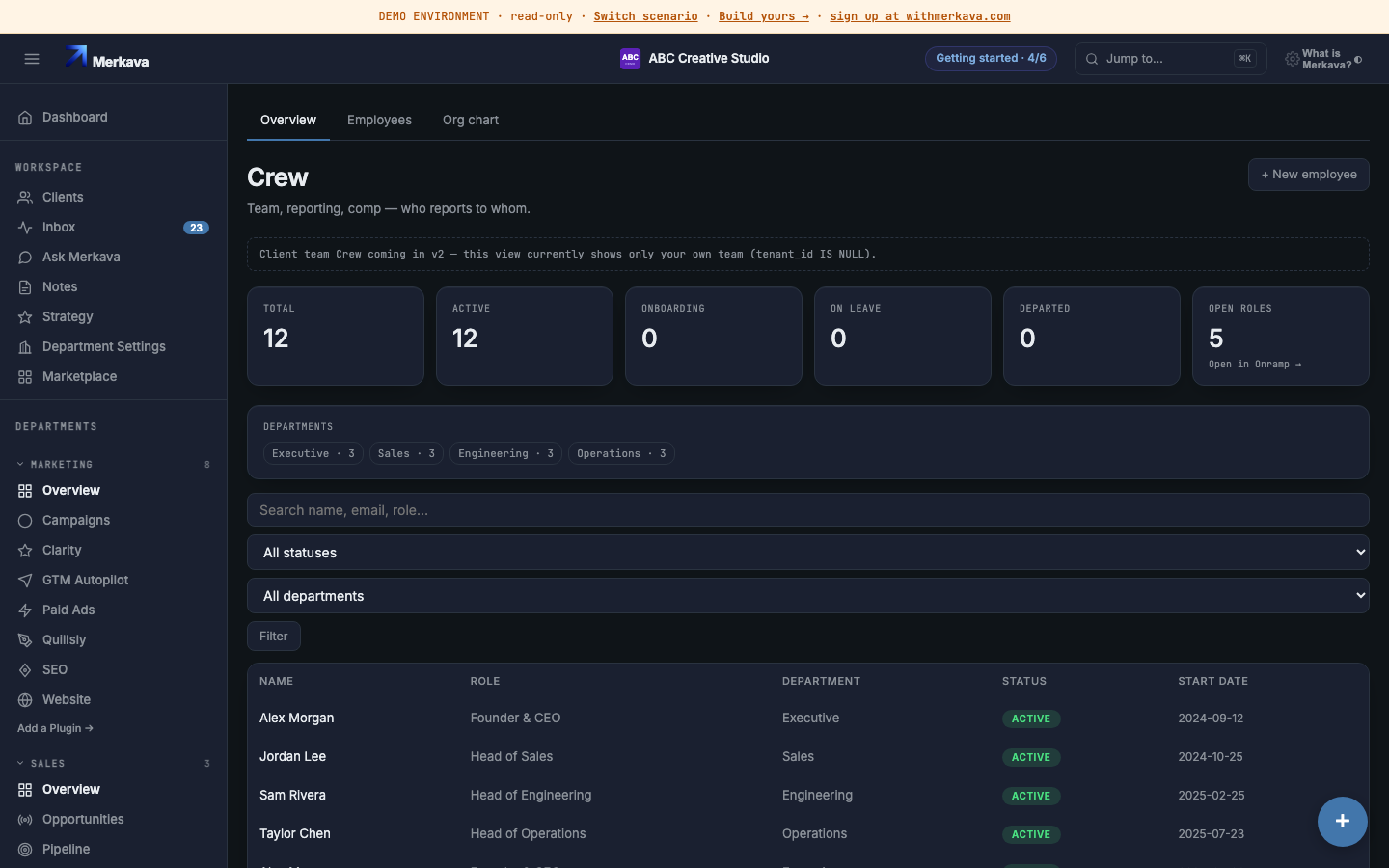
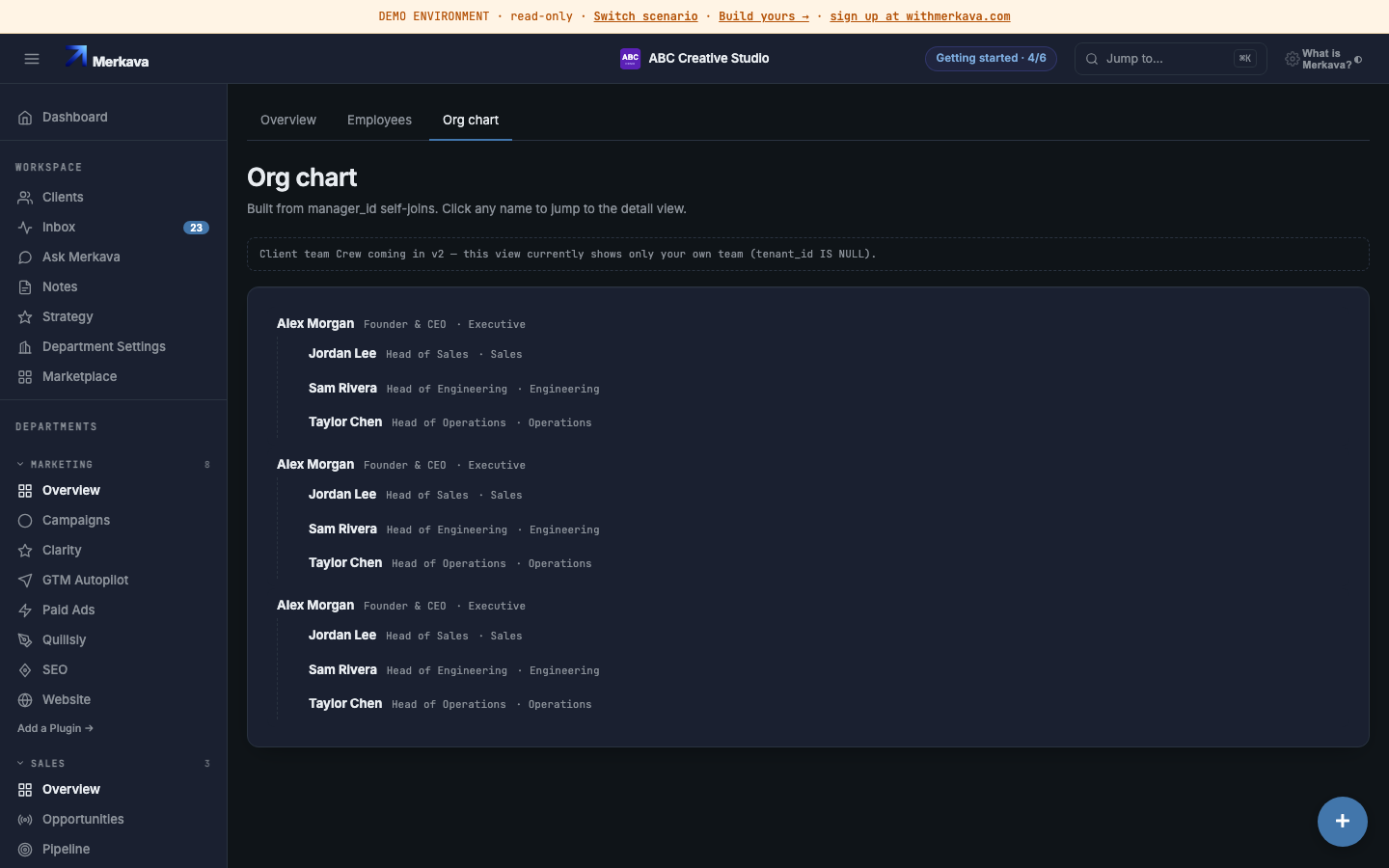
Crew. People + HR with a canonical employee record.
Crew is the source of truth for everyone who works at your company — employees, contractors, the AI specialists you hire from Merkava. It's the HR Director, included in the Operations department and run by your COO. Every other Drive that says "who did this" points back to Crew.
What Crew does.
One employee record
Login users, deal owners, candidate recruiters, content authors — all the same Crew record. No parallel users table. No reconciliation script when someone changes roles.
AI specialists are first-class
When you hire a department — Marketing, Sales, Operations — every specialist on it gets a Crew record too. The "owned by" field on a deal can point at a human or an AI — it's the same FK either way.
Tracks compensation + tenure
Title history, salary changes, equity grants, start/end dates. The Gauge Drive uses Crew for performance cycles. Onramp creates Crew records when a candidate gets hired.
When to use it.
- You're early enough that "who owns this customer" lives in someone's head
- You're scaling past 10 people and need a real source of truth instead of a spreadsheet
- You want the AI departments you hire and your humans to coexist in the same system, not two parallel orgs
Integrates with.
Pairs well with.
Questions.
Can I import my existing employee list?
Yes — Crew imports CSVs and connects to Gusto / Rippling for live sync of titles, departments, and start dates. Sensitive fields (salary, equity) are admin-only and travel with their own RBAC scope.
How does Crew handle contractors vs employees?
Both are Crew records, distinguished by employment_type. Tenure, comp, and access scopes work the same way — but downstream Drives (Gauge, Atlas) can filter by employment type when it matters.
My AI specialists get a Crew record? What does that mean?
When you hire a department (Operations, Marketing, Sales, etc.) each specialist on it appears in Crew with employment_type = ai_exec. Other Drives can attribute work to them the same way they'd attribute to a human — same FK, same UI.
How does Crew relate to RBAC?
RBAC roles attach to Crew records. The role determines which Drives a person can see and what they can do inside each. See the rbac-spec.md document for the full default-role matrix.
How is Crew different from Gusto, Rippling, or BambooHR?
Gusto and Rippling are payroll-first; Crew syncs from them but isn't a payroll system. BambooHR is an HRIS for 50-300 person companies — priced and configured for that scale. The HRIS subscription is the cheapest part of what you're getting: when you're 5-30 people without a head of HR, the value is the HR Director doing the work and the integration — one employee record visible everywhere in Merkava (Onramp candidates become Crew records, Gauge runs reviews against Crew, Centerline routes action items to Crew) instead of stitching a dozen silos together. Forge runs the function; you skip the headcount.
Multi-venture employee scoping?
Each Crew record is scoped to one venture by default; assign cross-venture for shared resources (a contractor working across two of your portfolio companies, your fractional CFO seeing all five). Cross-venture roll-ups in Portfolio view show team headcount, comp run-rate, retention across the entire studio.
What does Crew cost?
Crew is part of the Merkava core — included with every plan (it's one of the 4 core Drives along with Portfolio, Signals, Prospector). The unit you hire is the Operations department ($199/mo): the COO who runs Crew + Onramp + Centerline + Gauge + Cohort + Ignition + Relay together. You're hiring a department, not bolting on a tool. Or hire the whole Full C-Suite at $699/mo.
Try Crew in your Merkava workspace.
Hire the Operations department, or the whole Full C-Suite.